

Keeping the rally going: why social racket sports stop working past 12 people
Every group hits a wall. Past a certain size the WhatsApp chat stops being a tool and starts being the thing you dread checking. Here's what breaks, and how to fix it.
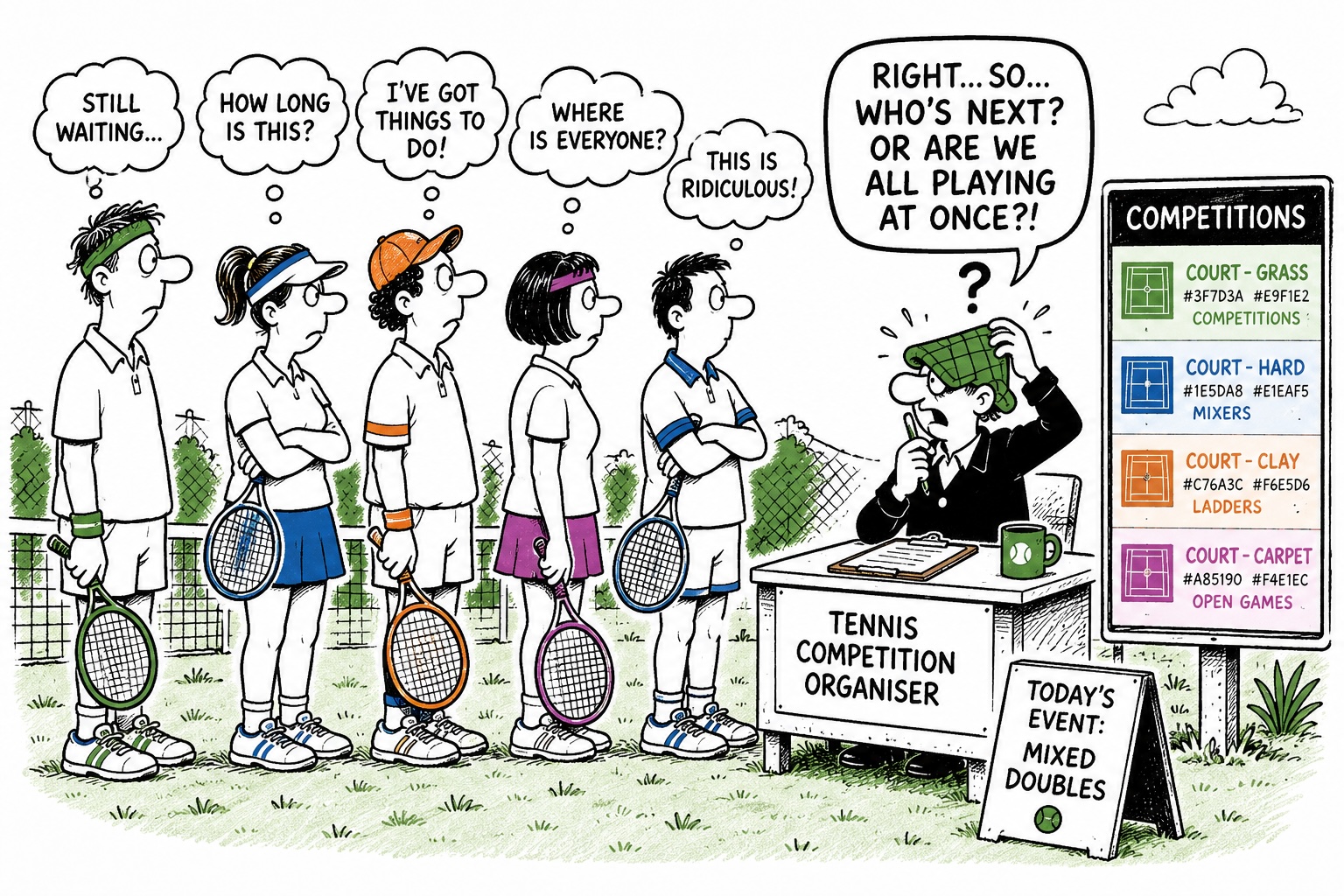
Every social tennis group I've watched grow past a dozen players hits the same wall. The WhatsApp chat that worked beautifully at six people becomes a job. Someone — usually the same person — ends up reading every reply, counting heads, balancing courts on the back of an envelope, and ferrying half a dozen "can I bring a mate?" messages. They burn out. The group shrinks. The rally stops.
This is not a people problem. It's a coordination problem dressed up as a people problem. Below: what specifically breaks, why it breaks at that size, and the three patterns that fix it.
The 12-person ceiling
A group of six is a list. A group of twelve is a system. The difference is invisible until you cross it.
At six, there is one court, one Saturday, and two replies to count. Everyone knows whether they're in. Pairings are obvious — you played with Sarah last week so this week you play with Tom.
At twelve, there are two courts (or three), more replies than you can keep in your head, and an emerging sense that some people are getting good games and some people are not. The hidden tax — who is balancing the courts, who is checking who is on the reserve list, who is texting the latecomer to say sorry there's no space — lands on one person.
Usually they enjoy it for about three months.
What actually breaks
Three things, and they break in this order.
1. Round-robin admin. The replies arrive over four days in no particular order. The organiser has to mentally maintain a register: in, out, maybe, maybe-yes-now-no, partner-of-someone-in. They check it on the train. They check it again at lunch. The mental cost compounds.
2. Fairness drift. Without a deliberate effort, the same four players end up on the same court most weeks — the ones who reply fastest, or who happen to be at a similar level to the organiser. New players play together because the organiser doesn't know who else would suit them. After a month, the social geometry of the group has solidified in a way nobody intended.
3. Loss of shared memory. Did Tom and Sarah play together last week? Three weeks ago? Who's only played with the same two people for a month? There is no shared source of truth except a frazzled organiser's head. So the answer is probably, and probably is the enemy of fairness.
What works
Three patterns. You can implement them with paper if you want; the point is not the tool, it's the discipline.
A fixed reserve list, visibly published. The moment "who's in?" becomes a private question, you've lost. The list lives somewhere everyone can see. People put themselves on it. People take themselves off it. The reserve list is part of the list, not a separate group chat. When someone drops, the top reserve gets promoted automatically. The organiser does not adjudicate.
Pairings the organiser doesn't have to draft from scratch. Some kind of algorithm — even a crude one — generates a draft set of courts based on the registered players. Manual override is allowed; manual origination is not. This sounds small. It is the entire game. Removing the blank-page problem from the organiser changes the job from "balance twelve people across three courts every week" to "look at this draft and tell me if you'd like to change anything".
A public source of truth. Pairings, results, the leaderboard, the ladder, the history — none of it lives in the chat. The chat shares a link. The link is the canonical answer to "what's happening?". When someone asks "did we play together last week?", they tap the link instead of paging the organiser.
The combination of these three is not a feature list. It is a redistribution of the coordination tax — from the organiser, who carries it disproportionately, back to the system, which was always the right place for it.
Why we built mixers the way we did
We built mixers as the default activity in Rallio because the doubles mixin is the purest expression of the problem. Singles is a transaction between two people. A doubles mixin is a social contract between a group: show up, get paired, play with different people, the algorithm handles fairness. The community runs itself.
The moment you let players sign up to a shared, visible list — and let the system draft balanced courts — the size ceiling moves. We've watched groups of four grow to forty without the organiser changing. They just stop being the bottleneck.
That's all this is, really. Keeping the rally going means keeping the organiser going.